1
/
of
2
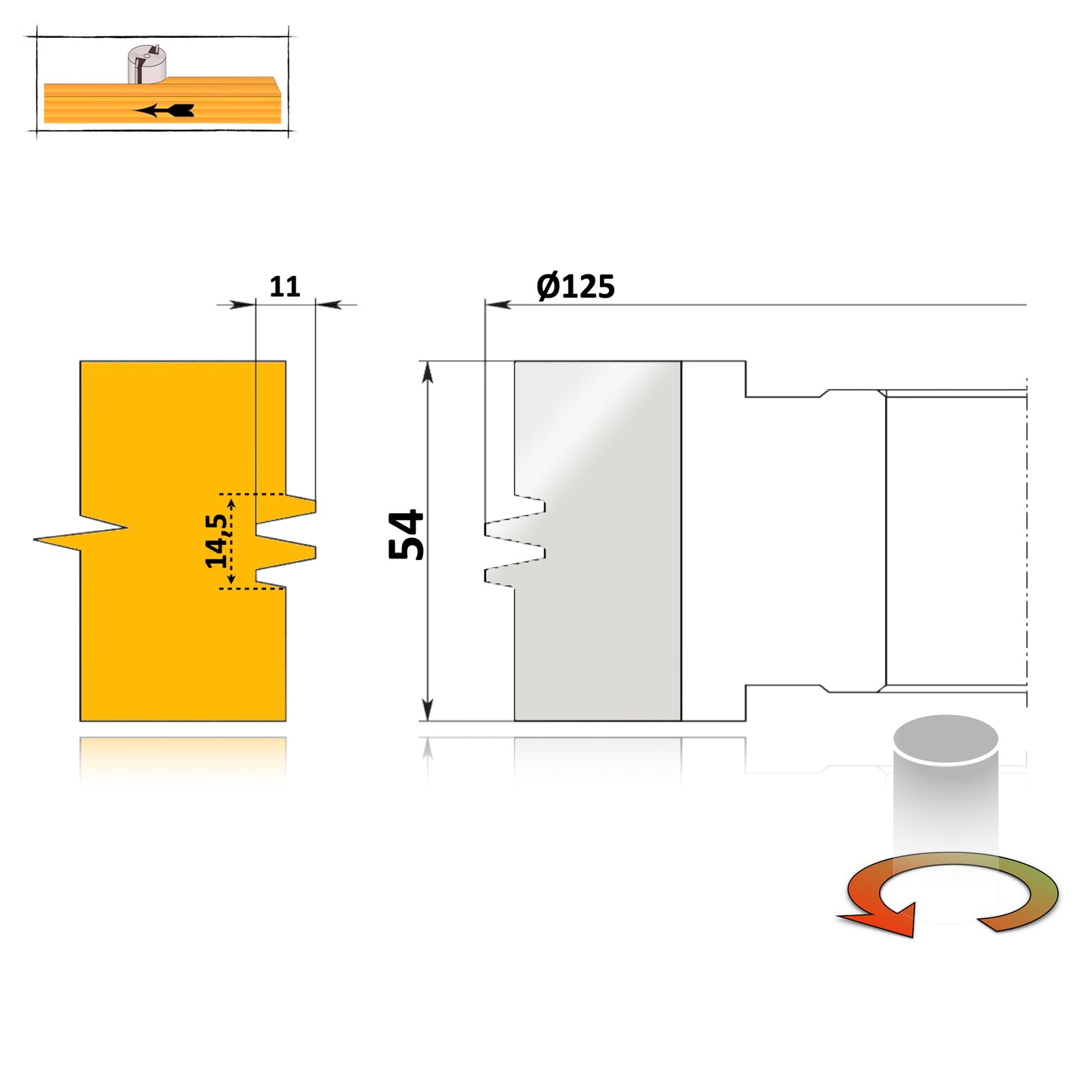
Finger Joint Cutter (Longitudinal) - 54 mm | Code K13 | HSS Premium
Finger Joint Cutter (Longitudinal) - 54 mm | Code K13 | HSS Premium
No reviews
SKU:K13-d32/30
Regular price
1.040,00 RON
Regular price
1.400,00 RON
Sale price
1.040,00 RON
Taxes included.
Shipping calculated at checkout.
Quantity
Out of stock
Couldn't load pickup availability
Longitudinal Laminated Jointing Cutters – 54 mm HSS M2 Premium
| Standard Shaft Bore (d) | Ø32 mm / Ø30 mm standard (Custom sizes also available upon request) |
| Active Cutting Material | Premium HSS M2 High-Speed Steel (High 6.5% Tungsten concentration) |
| Tooth Type & Brazing | Profiled lamellar inserts industrially brazed with premium silver alloy (Ag) |
| Body / Cutting Height | 54 mm (Ideal for a wide range of wooden panels) |
| Active Working Space | 20 mm - 50 mm (Optimized for longitudinal joints and solid panels) |
| Outer Diameter (D) | 125 mm (Ensures excellent dynamic inertia and consistent cuts) |
| Active Cutting Edge Hardness | 64 – 66 HRC |
| Recommended Speed | 6,200 RPM (Stable performance, prevents burn marks) |
| Manufacturing Warranty | Replaceable profiled inserts – a long-term investment in mass production |
| Country of Production | Ukraine |
✨ FEATURES AND DYNAMIC PERFORMANCE
- Precise and High-Strength Joints: Specifically designed for longitudinal lamellar joints, this tool provides an extended adhesive contact surface, ensuring perfectly flat panels and a solid, uniform, and structurally resistant bond over time.
- Industrial HSS M2 Performance: Thanks to its rich Tungsten composition (standard Р6М5), the fixed cutting edges maintain their geometric sharpness over thousands of linear meters in solid natural wood, offering exceptional resistance to overheating.
- Perfect Anti-Vibration Balance: The cutter body with an outer diameter of 125 mm is fully ground and dynamically balanced on precision CNC machines. This protects the router machine's bearings and eliminates micro-waves on the finished surface.
- Clean Cuts Without Compromise: The tooth rake angle is calculated to finely "shave" the soft or hard grain of natural solid wood, leaving perfectly smooth edges, ready for direct finishing, varnishing, or painting.
- Extended Compatibility: The monoblock architecture is optimized to work excellently on a wide variety of professional stationary router machines (shapers) in traditional or industrial carpentry workshops.
⚠️ Usage limitations for the version in this listing (HSS M2):
❌ NOT recommended for use on particleboard, MDF, HDF, or agglomerated panels!
❌ For pressed wood derivatives containing abrasive glues, request the version with T.C.T. Vidia inserts.
📌 Perfect for joining panels, countertops, and solid natural wood structures!
🛠️ Professional Selection Guide: HSS vs. T.C.T. Vidia
The correct choice of cutting edge material directly influences the quality of the finish and the tool's lifespan. Consult the table below:
| Material to be Processed | HSS M2 Premium ⭐ (6.5% W / Р6М5 - In stock option) |
T.C.T. Vidia ⭐ (Tungsten Carbide - In stock option) |
|---|---|---|
| Softwood (Spruce, Fir, Pine, Linden) |
⭐ 100% (Glossy Finish / No Burns) |
❌ Risk of burning (Due to localized friction) |
| Hardwood (Beech, Oak, Ash) |
80% (Structurally efficient) |
⭐ 100% (Maximum resistance) |
| MDF / Particleboard / HDF / Laminate | Not Recommended | 100% (Industrial optimum) |
| Composite & Exotic Materials | Prohibited | 100% (Maximum Yield) |
| Number of Resharpenings | Maximum (M2 resharpenable) | Structurally limited |
| Cutting Material Hardness | 64 – 66 HRC | 85 – 92 HRC |
✅ Practical conclusions for purchase:
- Do you produce panels/countertops from Spruce, Fir, or Pine? Stick with the version in this listing: HSS M2 Premium. The tooth geometry and high-speed steel density allow for perfect, effortless chipping, leaving knots and soft fibers extremely clean, completely eliminating the micro-fringing effect.
- Do you work with very dense solid wood or hard laminated essences? If your workshop predominantly processes dry Beech, Oak, or derivative materials with abrasive adhesives, opt for a configuration with a T.C.T. Vidia cutting edge to benefit from maximum carbide resistance to dulling.
- Speed adjustment: Use the tool within the recommended speed range (6,200 RPM). Smooth manual or mechanical feeding will ensure quick chip removal from the channel, preventing active cutting edges from overheating.
Share