1
/
of
3
Laminated Wood Joint Cutter Latitudinal 50 - 100 mm | D125 | d32 | Code - C04 | DS Steel
Laminated Wood Joint Cutter Latitudinal 50 - 100 mm | D125 | d32 | Code - C04 | DS Steel
No reviews
SKU:C04H50-d32
Regular price
500,00 RON
Regular price
Sale price
500,00 RON
Taxes included.
Shipping calculated at checkout.
Quantity
Low stock: 1 left
Couldn't load pickup availability
Width Jointing Cutter with Full Surface Teeth – DS Steel - DIY
| Standard Bore Diameter (d) | Ø32 mm 🛠️ Adaptation options: For a 30 mm shaft, reduction bushings are used (package discount!). For a 35 mm or 40 mm shaft, we offer the possibility of technical bore enlargement. |
| Active Cutting Edge Material | DS Steel (Special woodworking steel, ideal for DIY projects and economical budgets) |
| Performance Range | DIY Series – The optimal solution for moderate use, small workshops, and semi-professional projects |
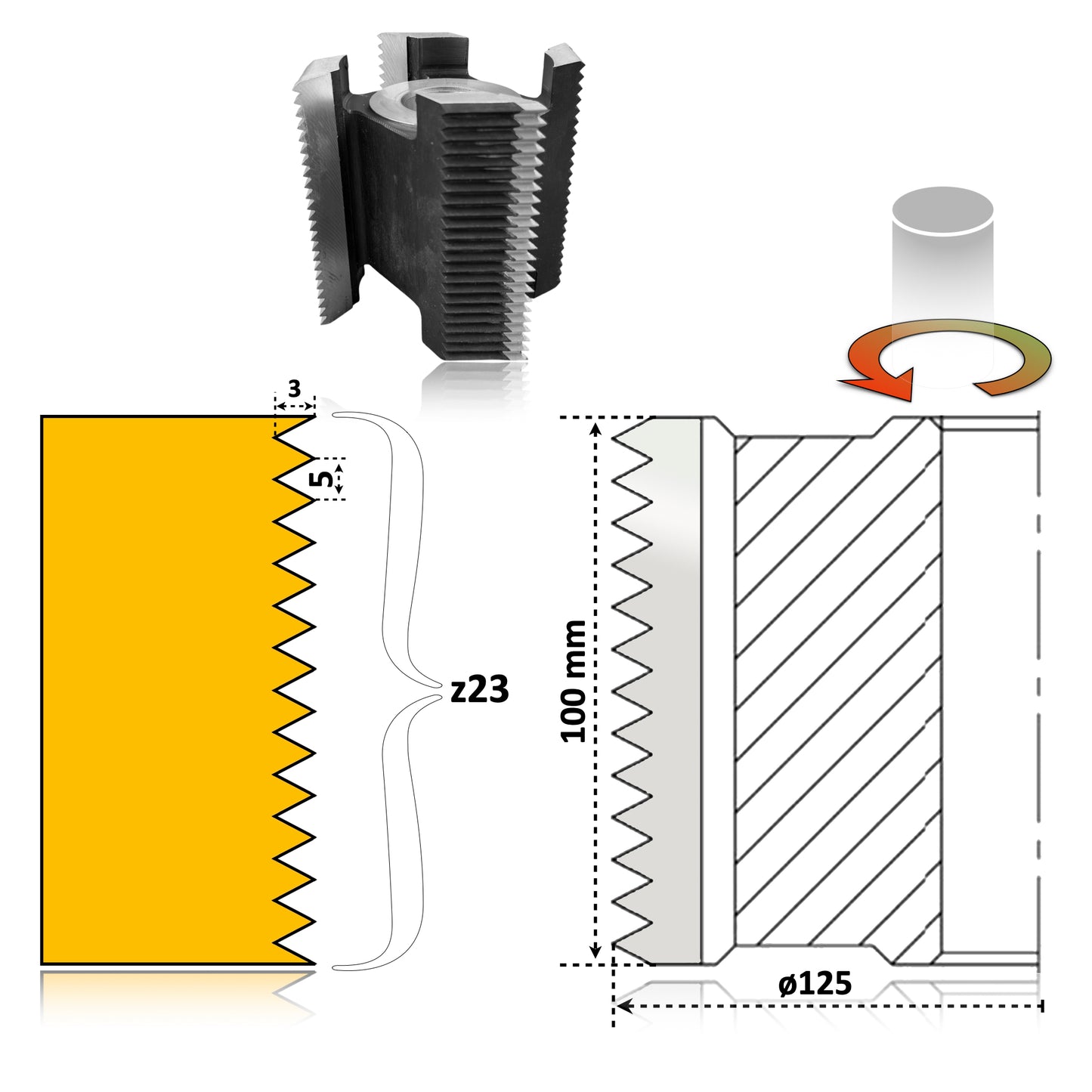
| Number / Type of Teeth | Z4 (4 pieces) – Industrial brazed profiled cutters with resistant copper alloy (Cu-Zn) |
| Active Working Area | 50 mm or 100 mm (Optional) – Flexible configuration depending on panel thickness |
| Outer Diameter (D) | 125 mm (Provides excellent stability during cutting) |
| Active Cutting Edge Hardness | 58 – 61 HRC |
| Recommended Speed | 6,000 RPM (Clean, constant, and safe cuts) |
| Execution Guarantee | Resharpenable and replaceable inserts – a smart long-term investment |
| Set Quantity | 1 pc. (Selected active height of 50 mm or 100 mm) |
| Country of production | Ukraine |
✨ PRODUCT FEATURES AND BENEFITS
- Professional Finger Jointing: The geometry with teeth across the entire active surface creates perfectly interlocking grooves. The profile exponentially increases the gluing surface, ensuring extreme resistance to torsion, pulling, or bending forces.
- Ideal Economic Solution (DIY Range): Made from structural DS Steel alloy, this cutter is specifically configured for small workshops, woodworking enthusiasts (DIY), or moderate work regimes, offering correct geometric performance at an extremely advantageous price.
- Clean, Gap-Free Finish: The cutter's teeth are computer-ground to ensure that the male-female profiles will join perfectly, without unsightly gaps or alignment errors along the panel length.
- Extended Compatibility: The 125 mm outer diameter and standard Ø32 mm bore make this tool easy to mount on most stationary woodworking milling machines in professional workshops.
📐 RECOMMENDED APPLICATIONS:
- Width jointing of boards, battens, and natural solid wood elements.
- Manufacturing of table tops, laminated panels for furniture, frames, and large structures.
- Handicraft, semi-professional, or residential carpentry projects where the aim is to eliminate wood defects and reuse short pieces.
💡 TECHNICAL ADJUSTMENT RECOMMENDATION FOR CRAFTSMEN:
To achieve a perfect counter-profile: For the final joint of the two wood pieces to be perfectly flush (without steps or unevenness on the surface), it is recommended that after milling the first piece, you lower or raise the cutter on the shaft by exactly half a tooth before milling the complementary piece.
⚠️ Usage limitations for the version in this listing (DS Steel - DIY):
❌ NOT recommended for use on chipboard, MDF, HDF, or exotic/very hard wood!
❌ Intended for processing natural softwoods (Spruce, Fir, Pine, Linden, etc.). For hardwoods or intensive industrial use, choose higher cutting edge grades.
🛠️ Professional Selection Guide: DS Steel vs. HSS vs. Carbide
The correct material choice directly influences the wear resistance of the teeth and the quality of the finish depending on the wood type. Consult the comparative table:
| Material Processed | DS Steel ⭐ (DIY Standard - This Cutter) |
HSS M2 Premium ⭐ (6.5% Tungsten / P6M5) |
T.C.T. Carbide ⭐ (Metal Carbides) |
|---|---|---|---|
| Softwood (Spruce, Fir, Pine, Linden) |
90% (Good / Economically Optimal) |
⭐ 100% (Impeccable finish, no burning) |
❌ Risk of burning (Due to local friction) |
| Hardwood (Beech, Oak, Ash) |
40% (Requires frequent sharpening) |
80% (Efficient and durable) |
⭐ 100% (Maximum structural efficiency) |
| MDF / Chipboard / HDF / Composites | Not recommended | Not recommended | 100% (Industrially optimal) |
| Number of Resharpenings | Standard (Usual) | Maximum (M2 resharpenable) | Limited by brazing |
| Cutting Edge Material Hardness | 58 – 61 HRC | 64 – 66 HRC | 85 – 92 HRC |
✅ Practical Conclusions for Purchase:
- Are you a DIY enthusiast or just starting a workshop? The DS Steel version in this listing is ideal. It offers you the ability to produce perfectly jointed softwood panels (Spruce/Pine) with minimal initial investment and correct performance.
- Do you have daily production or work with Oak/Beech? To avoid premature dulling caused by the density of hard fibers, we recommend choosing the superior version from our range with HSS M2 Premium high-speed steel cutting edge.
- Are you cutting derivative materials (MDF/Chipboard)? Binders and adhesives in pressed panels will quickly destroy standard steel cutting edges. For these abrasive materials, the only correct option is the version with T.C.T. Carbide inserts.
Share